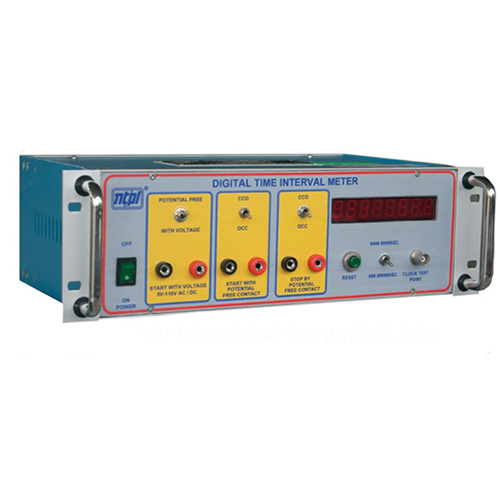
About NTT8DSA DIGITAL TIME INTERVAL METER
Scope
"NTPL" Digital Time Interval Meter can be used for calibration & also for testing with other Timer. The Time Interval Meter is made with extensive use of integrated circuit to achieve long and trouble free service.
Technical Features
Display :8 digit display with 7 segment LED (12.5mm).
Range:
- 0 - 999.99999 Sec. (Min. count: 000.00001 Sec. & Max. count: 999.99999 Sec.)
- 0 - 9999.9999 Sec. (Min. count: 0000.0001Sec. & Max. count: 9999.9999 Sec.)
Accuracy:+ 0.2% of rdg + 4 digit
Reset Facility: This is available in the form of push button switch.
Power Supply:230 volts + 10% at 50 Hz AC.
Latching : This facility is available for only withdrawal of clean +5V DC or change of NO to NC mode of contact.
Documents:
Operation Manual, Works Test Report, Warrantee Certificate will be supplied along with the set.
Note: The look, dimension & weight of the Test Set-up may vary at the time of manufacture due to design innovation.
The NTT8DSA Digital Time Interval Meter delivers accuracy down to 0.01 seconds, making it suitable for critical industrial and laboratory applications. Its reliable measurement minimizes errors in process control and automation, supporting cumulative, start-stop, interval, and ON delay modes. The robust panel mount design and sturdy ABS plastic housing ensure performance in demanding environments.
User-Friendly Operation and VersatilityFeaturing a clear 14 mm LED display and intuitive manual or remote reset options, the NTT8DSA simplifies monitoring and control. Its broad time range, flexible input signal compatibility, and standard panel cutout enable seamless integration into diverse systems. The device withstands up to 95% RH humidity and wide temperature variation, making it adaptable across various industries.
Safety and Standard ComplianceThis timer adheres to IS Standards, providing confidence in both its safety and reliability. With IP20 protection, robust insulation, and resistance to shock and vibration, the NTT8DSA is built for longevity even in rugged or high-traffic environments. Its mains-operated design ensures continuous operation, eliminating the need for batteries.
FAQ's of NTT8DSA DIGITAL TIME INTERVAL METER:
Q: How is the NTT8DSA Digital Time Interval Meter installed in an industrial setup?
A: The NTT8DSA is designed for panel mounting, fitting into a standard 96 x 96 mm cutout. It connects directly to a 230V AC power supply and accepts input signals via potential-free contact or 24V DC, facilitating seamless integration into automation panels and process control cabinets.
Q: What display features does the NTT8DSA offer for time measurement?
A: The device uses a 4-digit, 7-segment LED display with a 14 mm digit size, ensuring clear visibility of measured intervals up to 9999 seconds, even in low-light industrial environments. The straightforward interface aids in quick monitoring and adjustments.
Q: When should the manual or remote reset facility be used?
A: Choose manual reset when operators are physically present, such as during laboratory testing or process calibration. The remote reset option is ideal for automated or hard-to-access installations, allowing for system resets from a distance and improving process efficiency.
Q: Where can the NTT8DSA Digital Time Interval Meter be effectively used?
A: Its robust build and versatile functionality make it well-suited for industrial process timing, laboratory testing environments, automation panels, and any application requiring precise interval measurement under atmospheric pressure and variable humidity.
Q: What benefits does the compliance with IS Standards and IP20 protection bring?
A: Compliance with IS Standards ensures the meter meets recognized safety and performance criteria. IP20 protection, along with shock and vibration resistance and ABS plastic housing, provides durability and safe operation in demanding settings.
Q: How do users benefit from the mains-operated design of the NTT8DSA?
A: Operating on a 230V AC mains supply, the NTT8DSA eliminates the need for batteries, reducing maintenance and ensuring continuous, uninterrupted timing measurement critical for industrial applications.







 Send Email
 Send Inquiry

 Send Inquiry

 Send Inquiry
 Send SMS