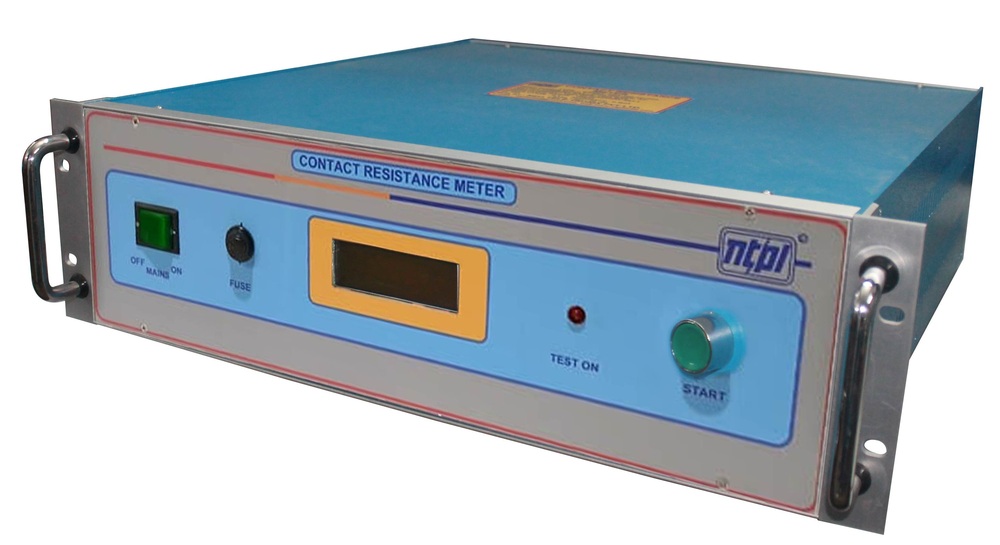
About "NTPL" MAKE CONTACT RESISTANCE METER
Technical features:
Input Power Supply : 230 Volts+/-10%, 50Hz,single phase AC.
Test Current : 100A DC.
Resistance Range : 200 (199.9 ) Resolution: 0.1 200 (1999 ), Resolution: 1
Accuracy : 0.5 %
Terminals : 4 terminal Measurement.
Display : LCD Display for indication of Resistance value across contact.
Operation Mode : Automatic, Current Injection time 30 Seconds max
Environment:
a) Operating temperature: 5 C to 50 C.
b) Humidity: 5% -95% RH, non-condensing.
The above Test unit will be single compact, rugged & portable type provided with handle for easy movement.
DOCUMENTS:
Operation Manual, Works Test Report, Warrantee Certificate will be supplied along with the set.
Approx. Dimension: L= 483 mm X W= 534 mm X H= 102 mm
Approx. Weight: 8 Kgs.
High-Precision Measurement & Advanced DisplayThe NTPL Contact Resistance Meter provides precise readings down to 1 micro-ohm, ensuring detailed detection of low resistance in electrical contacts. The digital LCD display allows clear visibility of measurements, while the 1 micro-ohm output resolution adds confidence to your results. Paired with a fast 2-sample-per-second rate and data hold function, users benefit from efficient and reliable assessments even in critical testing environments.
Robust Construction & Safety FeaturesDesigned for industrial settings, the meter features a corrosion- and impact-resistant, powder-coated steel cabinet with an aluminium front panel. Its built-in forced air cooling system maintains optimal temperature during extended use. Safety is prioritized through overload and short circuit protection, adherence to IS/IEC standards, and a chassis insulated for user protection, ensuring worry-free testing days.
Versatile Applications & User ConvenienceWith a measuring current up to 100A DC and supplied test leads of 5 meters, the NTPL Contact Resistance Meter is perfect for testing circuit breakers, busbar joints, switchgear, and other high-current connections. The compact, rack-mountable unit includes essential accessories like a carrying case, user manual, and calibration certificate for a seamless experience-from setup to recalibration.
FAQ's of "NTPL" MAKE CONTACT RESISTANCE METER:
Q: How do I operate the NTPL Contact Resistance Meter for accurate measurements?
A: To operate the NTPL Contact Resistance Meter, connect the provided 5-meter test leads to the points under test and switch on the device using the mains power supply (230V AC, 50Hz). Set the test current as needed (up to 100A DC) and observe the results on the digital LCD display. The data hold feature can freeze readings for documentation, while built-in safety mechanisms ensure protected operation.
Q: What types of electrical equipment can the NTPL Contact Resistance Meter test?
A: This meter is ideally suited for measuring low resistance values in high current contacts such as circuit breakers, busbar joints, switchgear, and similar components where precise contact resistance measurement is essential for performance validation and preventive maintenance.
Q: When should the NTPL Contact Resistance Meter be recalibrated?
A: The instrument is supplied factory calibrated but for sustained accuracy, annual recalibration is recommended. Calibration certificates are included, simplifying traceability and compliance with quality assurance standards.
Q: Where can recorded measurement data be stored or transferred from the NTPL meter?
A: Measurement data can be logged by connecting the optional RS232 or USB interface, allowing seamless transfer to a computer or data logging system for analysis and archival.
Q: What benefits does the NTPL Contact Resistance Meter offer over traditional measurement tools?
A: The NTPL Contact Resistance Meter offers high accuracy (0.5% of reading), digital data handling, fast sample rates, robust safety features, and a corrosion-resistant cabinet, making it superior for demanding industrial environments and ensuring reliable results.
Q: How does the NTPL meter ensure user safety during operation?
A: The meter incorporates multiple safety features including overload and short circuit protection, adherence to IS/IEC safety standards, built-in insulation, and audible/visual indicators for continuity checks, minimizing risk during field and laboratory use.








 Send Email

 Send Inquiry


 Send Inquiry


 Send Inquiry
 Send SMS
